BPMN for Business Analysts
BPMN (Business Process Model and Notation) is a standard way to draw business processes, maintained by the Object Management Group (OMG). Because the symbols have agreed meanings, a BPMN diagram can be read the same way by a business user, another analyst and a developer. These tutorials use bpmn.io, a free tool that runs in the browser, so you can follow along without installing or buying anything.
The building blocks
Most BPMN diagrams use only a few elements. Events (circles) show where a process starts and ends, or something that happens along the way. Tasks (rounded rectangles) are the work. Gateways (diamonds) are decisions and parallel paths. Sequence flows (solid arrows) show the order of steps inside one process. Pools and lanes show who does each step, and message flows (dashed arrows) show communication between separate participants, such as a customer and a shop.
Learn those well and you can draw most real processes. The full standard has many more symbols, but the cheat sheet lesson shows which ones are worth learning next.
Where to start
Start with the BPMN tutorial for beginners, then the gateways lesson, because gateways are where most diagrams go wrong. Next, pools and lanes and message flow, which together show who does what and who talks to whom. The returns process and payment failure lessons then put it all together on a realistic example, including the unhappy path that many first diagrams forget.
Common mistakes
Using a sequence flow between two pools: between participants you need a message flow. Leaving a gateway's outgoing paths unlabelled, so nobody knows which condition leads where. Forgetting to merge paths back together after a split. And drawing the to-be process before the as-is: you can't show what will change until everyone agrees on how it works today. The as-is to to-be lesson models today's process first, then changes a copy into the new one.
The videos
13 videos, in the order we suggest watching them.
 BPMN Tutorial for Beginners: Your First Process Model
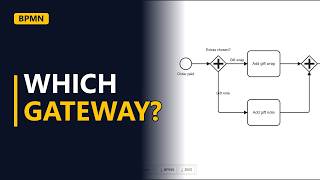 BPMN Gateways Explained: Exclusive vs Parallel vs Inclusive
 BPMN Pools and Lanes: Show Who Does Each Step
 Message Flow vs Sequence Flow in BPMN: Talking Between Pools
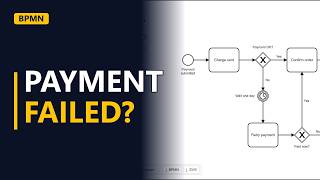 Model a Payment Failure Path in BPMN (Retry, Then Cancel)
 BPMN Example: Online Shop Returns Process
 BPMN 2.0 Elements Explained: Events, Activities, Gateways, Flows
 BPMN Notation Cheat Sheet: The 10 Symbols BAs Use Most
 From BPMN Sketch to Camunda-Ready Model: User and Service Tasks
 BPMN Collaboration Diagram: Customer, Shop and Courier
 Workflow Patterns in BPMN: Sequence, Split, Join and Loop
 As-Is vs To-Be Process in BPMN: Model the Change
 BPMN Example: Online Shop Order to Delivery Process