
Recommended hosting
Hosting that keeps up with your content.
This site runs on fast, reliable cloud hosting. Plans start at a few dollars a month — no surprise fees.
Affiliate link. If you sign up, this site may earn a commission at no extra cost to you.
⏱ 23 min read
Most people think customer satisfaction is a straight line. You give them what they ask for, they smile. You give them more, they are happier. This is a fundamental error in product strategy. It assumes that every feature a customer mentions is equally important and that adding more features always drives joy.
Here is a quick practical summary:
| Area | What to pay attention to |
|---|---|
| Scope | Define where Using the Kano Model Technique to Exceed Customer Expectations actually helps before you expand it across the work. |
| Risk | Check assumptions, source quality, and edge cases before you treat Using the Kano Model Technique to Exceed Customer Expectations as settled. |
| Practical use | Start with one repeatable use case so Using the Kano Model Technique to Exceed Customer Expectations produces a visible win instead of extra overhead. |
The reality is far messier and more expensive. If you build a feature because a customer asked for it, but they didn’t actually need it, you’ve just wasted engineering time and money on “noise.” Worse, if you ignore a feature they secretly need but haven’t voiced, you risk losing them to a competitor who figured it out first.
Using the Kano Model Technique to Exceed Customer Expectations solves this by distinguishing between what customers say they want and what they actually value. It separates the “must-haves” that keep you in the game from the “delighters” that make you the game. It forces you to stop guessing and start classifying.
This isn’t just theory; it’s a filter for decision-making. It stops you from building the wrong things and helps you find the hidden gems that turn a satisfied user into a fan. Let’s look at how to apply this without turning your product roadmap into a spreadsheet graveyard.
Understanding the Five Dimensions of Customer Preference
The Kano Model, developed by Nobuo Kano in the late 1960s, was designed to help companies understand the difference between basic expectations and unexpected delights. Before you can use the technique, you must understand that customer preference is not static. It is dynamic, shifting as the market matures and technology advances.
At its core, the model relies on a specific interview method where customers are asked two questions about a specific feature: one assuming the feature is present (“How do you feel if it is included?”) and one assuming the feature is absent (“How do you feel if it is not included?”).
Based on their answers, features fall into one of five categories. Knowing where your product sits in these categories is the first step in determining your next move. You cannot treat a “Must-Be” feature the same way you treat an “Excitement” feature.
The Must-Be Quality: The Silent Threshold
These are the features customers expect as a given. They rarely mention them until something goes wrong. If a hotel room has a clean floor, the guest says nothing. If the floor is dirty, they are furious.
In software, this is often the baseline of functionality. If you are building a password manager, encryption is a Must-Be. If you are selling a car, brakes are a Must-Be. These features do not generate satisfaction on their own; they merely prevent dissatisfaction. You cannot “add” these features to delight a customer because you already have them.
The danger here is complacency. Because these features don’t generate excitement, teams often neglect them. They assume “everyone knows this is necessary.” This is where products fail quietly. Competitors don’t need to innovate; they just need to ensure the basics work. If your brakes fail, you lose the customer instantly. If your encryption is weak, you are liable.
Key Takeaway: Do not invest in Must-Be qualities as growth levers. Your goal with these is simply to ensure they never cause dissatisfaction.
The One-Dimensional Quality: The Satisfaction Curve
This is the most common category. Here, satisfaction is directly proportional to performance. The better the feature, the happier the customer. The worse the feature, the angrier they get.
Think of battery life on a smartphone. A 12-hour battery is fine. A 24-hour battery is great. A 4-hour battery is terrible. Unlike the Must-Be category, improvements here do generate satisfaction and allow you to exceed expectations. However, the curve flattens at the top. Going from 12 to 24 hours feels amazing. Going from 100 to 101 hours feels negligible, even if the customer technically asked for “maximum battery.”
Using the Kano Model Technique to Exceed Customer Expectations involves recognizing where you are on this curve. Are you in the zone of diminishing returns? If you are already at the high end of performance, pouring more resources into this feature yields low ROI. Instead, you might want to look for an Opportunity Excitement feature that offers a new way to solve the problem.
The Attractive Quality: The Surprise Factor
These are the features that delight customers when present but do not cause them to complain when absent. They are the “wow” moments.
A classic example is the “Dark Mode” on an app. Early on, users didn’t ask for it. They didn’t know they needed it. When it appeared, they were thrilled. They felt the company “got” them. However, if you release an app without Dark Mode, nobody screams, “You are a terrible company!” They just don’t use it at night.
This is the sweet spot for innovation. Attractive qualities are often found by observing user behavior rather than just listening to user requests. Users often cannot articulate a need until it is solved for them. By anticipating these needs and building them in, you create a sticky advantage that competitors struggle to replicate because they are solving problems users haven’t voiced yet.
Caution: Be wary of mistaking Must-Be qualities for Attractive ones. What is a delighter today will become a must-have tomorrow as competitors adopt it.
The Indifferent Quality: The Dead Weight
These are features that customers neither care about nor dislike. They are irrelevant noise. Adding them consumes resources without changing the user’s perception of value.
For instance, if you add a physical CD drive to a modern laptop, most users will be indifferent. They don’t need it. It adds bulk and weight. If you add a complex feature that only 0.1% of your users would ever touch, you are likely building Indifferent Quality.
The Kano Model Technique helps you identify these so you can cut them. Every line of code written for an indifferent feature is a line of code not written for a delighting feature. In an age of short attention spans and limited bandwidth, removing indifferent features can actually improve the user experience by making the product feel lighter and more focused.
The Reverse Quality: The Deal Breaker
This is the dangerous category. Here, the presence of the feature causes dissatisfaction, while its absence causes satisfaction. Customers are actively opposed to the feature.
A common example is a software update that changes the UI without warning, making a previously intuitive workflow confusing. Users hate the new layout; they miss the old one. Or consider a product that requires mandatory two-factor authentication for every single action. It might be “secure,” but if it makes the app unusable, it falls into the reverse category.
Ignoring Reverse Quality is fatal. If you build a feature that users hate, you actively push them away. Using the Kano Model Technique to Exceed Customer Expectations means you must actively survey for these features. Sometimes, what a customer initially asks for is actually a reverse feature because they are describing a solution that doesn’t fit their actual workflow.
Implementing the Survey Method: Asking the Right Questions
Theoretically, the Kano Model sounds simple. Practically, it requires discipline. You cannot just guess where a feature fits; you must ask customers. The standard method involves a survey with paired questions. This is often the most overlooked step in implementation.
To classify a feature, you need to know how the user feels in two states: State A (Feature is Present) and State B (Feature is Absent). You must ask these questions for every feature you are evaluating. The answers are coded into a matrix, and the pattern determines the category.
Here is how the coding works. You ask:
- If the feature is present, how do you feel? (Delighted, Satisfied, Indifferent, Annoyed, Very Annoyed)
- If the feature is absent, how do you feel? (Delighted, Satisfied, Indifferent, Annoyed, Very Annoyed)
Based on the combination of answers, you assign the feature to a category. For example, if a user says they are “Delighted” when the feature is present but “Indifferent” when it is absent, it is an Attractive Quality. If they say “Satisfied” for both, it is a One-Dimensional Quality. If they say “Annoyed” when present and “Satisfied” when absent, it is a Reverse Quality.
The challenge is that users often lie or misjudge. They might claim they would be “delighted” by a feature they don’t understand, or they might assume that a feature is a “must-have” simply because it is industry standard. This is why the survey must be iterative. You run the initial classification, build a prototype, observe usage, and re-survey. The Kano Model is not a one-time audit; it is a continuous feedback loop.
Practical Insight: Never rely on a single survey round. User perceptions shift as product capabilities mature. Re-classify features every quarter.
To make this manageable, you don’t need to survey for every single button in your app. Focus on high-impact features, major product changes, or new product lines. If you are launching a new module, run the survey before development starts. If you are iterating on an existing feature, do it after a few cycles of use.
The survey format should be clear and avoid jargon. Instead of “This feature adds value,” ask “How would you feel about [Feature Name] being included in the software?” Keep the options simple. The goal is to get a raw data point, not a philosophical essay from the user.
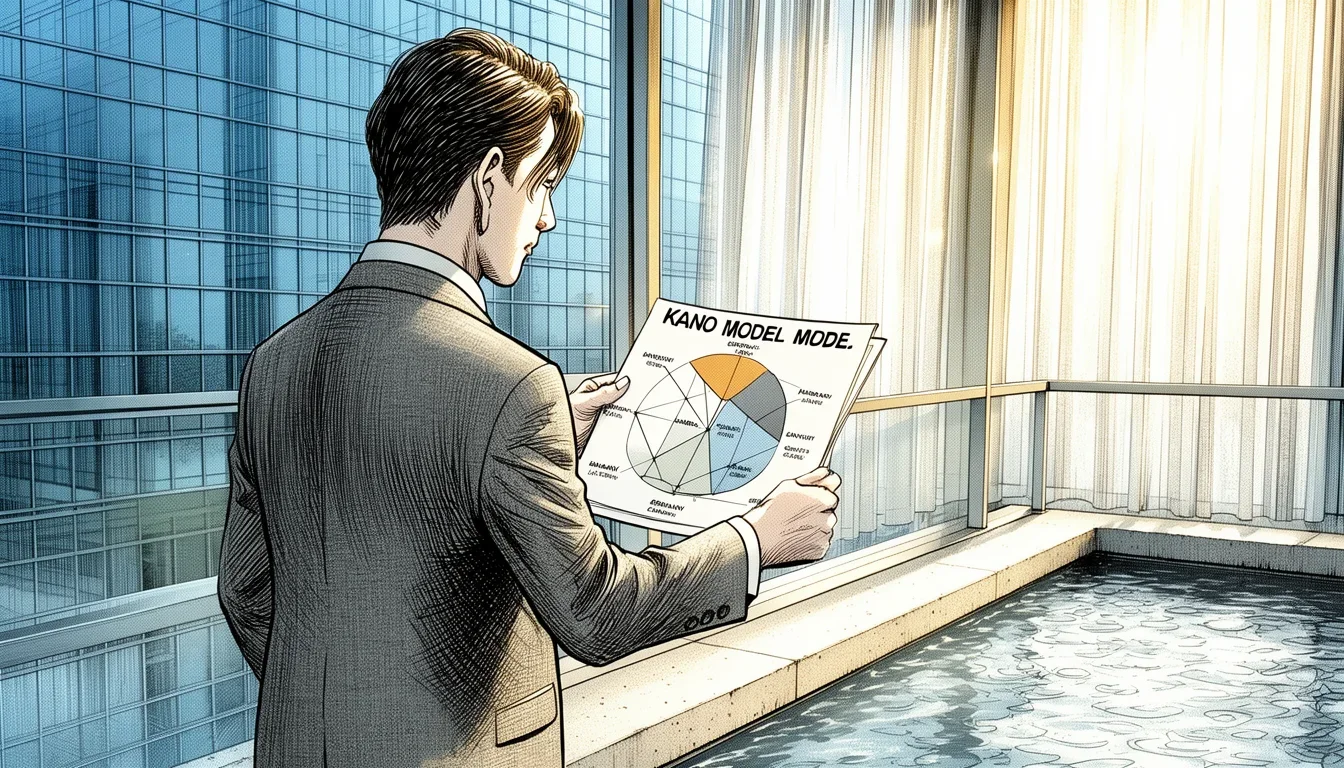
Once you have the data, you plot it on the Kano Matrix. This visual representation is powerful. It shows you exactly where your product stands. It might reveal that you have a cluster of features that are all One-Dimensional, meaning you are just churning out performance upgrades. It might show you have no Attractive features, meaning you are playing defense and haven’t innovated in years. The matrix forces you to see the imbalance in your portfolio.
Strategic Roadmapping: Allocating Resources Across Categories
Once you have classified your features, the real work begins: deciding what to build. You have a list of Must-Be, One-Dimensional, Attractive, Indifferent, and Reverse features. Now, where do you put your budget and engineering hours?
The Kano Model provides a clear hierarchy for resource allocation. You cannot maximize everything at once. Resources are finite. You must prioritize based on the category.
Step 1: Eliminate and Fix the Reverse
Before you build anything new, you must address Reverse Quality features. These are actively harming your product. If you have a feature that users hate, remove it or redesign it immediately. No amount of marketing can compensate for a product that frustrates the user. If a feature is Reverse, it is a liability. Cut it.
Step 2: Secure the Must-Be
Next, ensure all Must-Be qualities are functioning flawlessly. These are your foundation. If they are broken, nothing else matters. However, once they are stable, stop treating them as growth opportunities. Do not market them as innovations. They are the table you sit at. The goal is maintenance, not expansion. If you find new Must-Be requirements through market changes, add them, but don’t expect them to drive growth.
Step 3: Optimize the One-Dimensional
This is where the bulk of your competitive battle takes place. You need to ensure your One-Dimensional features are performing at a level that satisfies the majority of your users. But be careful. Do not over-engineer. If you are already at the point where 90% of users are satisfied, pushing to 95% might not be worth the cost. Use the Kano data to find the “knee” of the curve where the benefit plateaus. Invest in the features that offer the best ratio of satisfaction gain to development cost.
Step 4: Cultivate the Attractive
This is the engine of growth. Attractive qualities are your differentiator. They are the features that make users say, “I love this.” Prioritize the development of new Attractive features. These should be based on observation, not just requests. Look for gaps in the market. Look for ways to simplify complex tasks. Look for ways to personalize the experience.
When you have excess resources, you can even convert a One-Dimensional feature into an Attractive one. This is often done by adding a unique twist to a standard feature. For example, standard cloud storage is One-Dimensional (more space = better). If you add an AI feature that automatically organizes files, you have added an Attractive layer to a standard utility.
Step 5: Cut the Indifferent
Finally, look at your Indifferent features. These are the dead weight. If you have the budget to cut a feature that no one cares about, do it. Removing bloat makes the product faster, easier to understand, and cheaper to maintain. Sometimes, the best way to exceed expectations is to remove the noise that distracts from the core value proposition.
This strategic approach prevents the common mistake of “feature creep.” Teams love to say, “If we add this, users will be so happy.” The Kano Model stops that impulse. It forces you to ask, “Happy about what? Are we adding a Must-Be, a Delighter, or just Indifferent noise?”
Common Pitfalls in Applying the Kano Model
Even with a solid theoretical understanding, teams often stumble when applying the Kano Model Technique to Exceed Customer Expectations in the real world. The model is simple on paper, but the execution is fraught with traps. Recognizing these pitfalls is essential for success.
The “Voice of the Customer” Trap
The biggest mistake is assuming that what customers say they want is what they need. Customers are often bad at articulating their own needs. They might ask for a specific button layout, but they actually need a faster workflow. If you build exactly what they asked for, you might miss the underlying problem.
The Kano Model helps here because it looks at feelings, not just requests. But if you only survey the most vocal users, you might skew the results. Vocal users often have extreme opinions. They might demand a feature because it solved a unique problem for them, making it seem like a Must-Be for everyone. In reality, it might be an Indifferent feature for 90% of the user base.
To avoid this, you need a representative sample. You cannot just ask your top 10 customers. You need to survey the median user. The feelings of the average user matter more for mass-market products than the desires of the power users. Also, remember that users often project their desires onto you. “I wish this app had X” might just mean “I wish I had more time.” The feature X might not be the solution.
The Static View Fallacy
Another common error is treating the Kano classification as permanent. A feature that is a Delighter today will become a Must-Be tomorrow. When Apple introduced Face ID, it was a Delighter. Now, it is a Must-Be for premium phones. If you stop investing in Face ID as a differentiator and treat it as a baseline, you lose your edge.
You must re-evaluate your Kano matrix regularly. Market maturity accelerates. Features that were once novel become standard. If you don’t move your resources to the next wave of Attractive features, you will find yourself playing catch-up. The model is a snapshot in time, not a map of the future. It tells you where you are now, not where you will be in five years.
The False Dichotomy
Sometimes, a feature seems to fall into two categories depending on how you ask. For example, a “Dark Mode” toggle might seem like a Delighter, but if it causes battery drain issues on certain devices, it becomes an annoyance. The context matters. The Kano Model requires you to be specific about the feature definition. “Dark Mode” is vague. “Dark Mode with automatic switching based on ambient light” is a specific feature.
Vague definitions lead to vague results. You cannot classify a fuzzy idea. You must define the feature precisely before you run the survey. If you are unsure, run two scenarios. One with the feature as described, and one with a variation. This helps you understand the nuance and ensures the classification is accurate.
Over-Reliance on Quantitative Data
While surveys are quantitative, the Kano Model is inherently qualitative. It relies on understanding feelings. A number like “80% satisfaction” doesn’t tell you why they are satisfied or what would make them delighted. You need to combine the Kano Matrix with user interviews and usability testing.
The survey gives you the category, but the interview gives you the story. If the survey says a feature is a Must-Be, ask a user why. What happens if it’s missing? Their answer will reveal the emotional weight of the feature. Without this context, you might prioritize the wrong things. The numbers guide you, but the human element explains the numbers.
Integrating Kano with Other Frameworks
The Kano Model is powerful, but it doesn’t work in a vacuum. To truly exceed customer expectations, you should integrate it with other strategic frameworks. This creates a more robust decision-making engine.
Combining with the RICE Scoring Model
The RICE framework (Reach, Impact, Confidence, Effort) is great for prioritizing tasks. It helps you decide what to do next based on volume and difficulty. The Kano Model helps you decide what matters most in terms of customer emotion.
You can combine them by running Kano on your backlog first. This filters out the Reverse and Indifferent features, leaving you with Must-Be, One-Dimensional, and Attractive items. Then, you apply RICE to the remaining list. This ensures you aren’t wasting RICE points on features that don’t drive satisfaction or joy. You prioritize the Attractive features with high Impact and high Confidence, ensuring you are investing in the right growth levers.
Pairing with the MoSCoW Method
MoSCoW (Must have, Should have, Could have, Won’t have) is a classic prioritization technique. It sounds similar to Kano, but it lacks the nuance of the “Delighter” category. In MoSCoW, everything is either a Must or a Could. The Kano Model refines this. It tells you that some “Musts” are boring, and some “Coulds” are actually your biggest opportunity.
By overlaying Kano on MoSCoW, you can identify which “Could have” features are actually high-value Attractive qualities. This prevents you from treating all “Could have” items equally. You might decide to push a specific “Could have” to the top of the queue because the Kano analysis shows it has high potential for delight. This hybrid approach gives you the structure of MoSCoW with the emotional intelligence of Kano.
The Role of Job Stories
Finally, don’t forget that features exist to solve jobs. The Kano Model classifies the feature, but the Job Story (“When I [situation], I want to [motivation], so I can [outcome]”) defines the context. A feature might be a Delighter in one context and a Must-Be in another.
For example, a “Undo” button is a Must-Be for a data entry app. It is essential. But for a creative design app, it might be a Delighter if it offers a non-destructive history. Understanding the job the user is trying to get done helps you interpret the Kano results correctly. Don’t just look at the feature; look at the value it delivers in the user’s workflow.
Real-World Application: A Case Study in Evolution
Let’s look at a hypothetical scenario to see how this works in practice. Imagine a SaaS company building a project management tool. They have a backlog of 50 ideas. They run a Kano survey with 500 users.
The results come back with a mix of categories. They find that “Dark Mode” is an Attractive Quality. Users are delighted by it, but don’t complain if it’s missing. They find that “Offline Mode” is a One-Dimensional Quality. Without it, users are annoyed; with it, they are happy. They find that “Automatic Time Tracking” is a Reverse Quality. Users hate it because it feels invasive.
Here is how they pivot their roadmap:
- Cut: They immediately drop the Automatic Time Tracking feature. It’s a Reverse Quality. It’s hurting their core value proposition by annoying users. They might replace it with a less intrusive manual timer.
- Secure: They audit their “Offline Mode.” It works, but it’s buggy. They allocate a sprint to fix the bugs. It’s a One-Dimensional feature, so it needs to be reliable, but they don’t need to over-engineer it beyond a certain point.
- Build: They greenlight the Dark Mode project. It’s low cost, high impact, and fits the Attractive category. It gives them a chance to delight users without a massive investment.
- Ignore: They look for features that were marked as Indifferent, like a specific type of calendar view that only 5% of users use. They remove it to simplify the UI.
Over the next quarter, they release these changes. User feedback shifts. The “delight” from Dark Mode leads to higher retention. The reliability of Offline Mode reduces support tickets. The removal of the invasive time tracker reduces churn. They have used the Kano Model Technique to Exceed Customer Expectations by focusing their energy on what actually matters.
This isn’t magic. It’s just disciplined prioritization. It forces you to look at your product through the eyes of the user, not the eyes of the engineer who loves building cool things. The engineer wants to build the time tracker; the user wants to stop being tracked. The Kano Model helps you hear the user.
The Future of Expectation Management
As we move further into the age of AI and hyper-personalization, the Kano Model becomes even more critical. The definition of “basic” is shrinking. What was a Delighter five years ago is now a Must-Be. The bar is constantly rising.
Using the Kano Model Technique to Exceed Customer Expectations in this environment requires speed. You cannot wait for a full survey cycle to see if a new AI feature is a Delighter. You need rapid prototyping and continuous feedback loops. The model is no longer a quarterly exercise; it’s a daily habit.
The line between Attractive and One-Dimensional is blurring. With AI, features can be personalized. A “smart” suggestion engine might be a Delighter for most users, but for power users who know their data inside out, it might be a Reverse Quality if it gets in the way. The model helps you navigate these nuances by constantly re-evaluating the user’s emotional state.
Ultimately, the goal is not to satisfy everyone. It is to create a product that feels intuitive, delightful, and respectful of the user’s time. The Kano Model provides the vocabulary to describe that feeling. It gives you the tools to move beyond “we did what they asked” to “we gave them what they didn’t know they needed.”
In a world of endless options, the product that understands the subtle difference between a requirement and a desire will win. That is the promise of the Kano Model. It is not just a chart; it is a mindset shift. It reminds you that satisfaction is not the absence of pain; it is the presence of joy. And joy, in product design, is a feature you have to engineer intentionally.
Final Thought: The best products are not the ones with the most features; they are the ones that feel like they were built specifically for you.
By using the Kano Model Technique to Exceed Customer Expectations, you stop guessing and start knowing. You stop building noise and start building signal. You stop chasing satisfaction and start chasing delight. That is the difference between a good product and a great one. And in the long run, that is the only metric that truly matters.
Frequently Asked Questions
How often should I run a Kano survey for my product?
You should run a Kano survey whenever you are launching a new feature, a new product line, or when you suspect your product’s baseline has shifted. For mature products, a quarterly review of the feature portfolio is recommended to catch the transition of Attractive qualities into Must-Be qualities. It is not a one-time setup but a recurring strategic ritual.
Can the Kano Model be used for physical products?
Yes, the Kano Model is widely used in manufacturing and hardware. It applies to anything where user preference can be measured. For example, a car manufacturer might use it to determine whether a heated steering wheel is a Delighter or a Must-Be based on the market segment. The logic remains the same regardless of whether the product is digital or physical.
What if the survey results are inconclusive or conflicting?
Inconclusive results often mean the feature definition is too vague or the sample size is too small. If users give mixed answers, refine the feature description and re-survey. Conflicting results might indicate different user segments have different needs. In this case, segment your data. What is a Delighter for power users might be a Reverse Quality for casual users. Treat them as separate categories.
How do I handle features that seem to be both Attractive and One-Dimensional?
This is common. A feature might be a Delighter at a low level of performance but a One-Dimensional quality at a high level. For example, a fast search bar is a One-Dimensional feature (faster is better). But adding voice search to that search bar is an Attractive feature. You can layer Kano categories. The core function is One-Dimensional; the innovation on top is Attractive. Prioritize the innovation to exceed expectations.
Does the Kano Model guarantee higher customer satisfaction?
No, the model is a tool for prioritization, not a guarantee. It helps you allocate resources to the features that have the potential to drive satisfaction. However, poor execution, bad design, or lack of market fit can still result in failure. The Kano Model ensures you are building the right things, but it doesn’t ensure you build them well.
Is the Kano Model difficult to implement in large organizations?
It can be, primarily due to the survey process and the need for cross-functional alignment. Sales, engineering, and product teams often have conflicting views on what is important. Implementing Kano requires a unified language for discussing customer value. Start small with a pilot project to demonstrate value before rolling it out company-wide.
Use this mistake-pattern table as a second pass:
| Common mistake | Better move |
|---|---|
| Treating Using the Kano Model Technique to Exceed Customer Expectations like a universal fix | Define the exact decision or workflow in the work that it should improve first. |
| Copying generic advice | Adjust the approach to your team, data quality, and operating constraints before you standardize it. |
| Chasing completeness too early | Ship one practical version, then expand after you see where Using the Kano Model Technique to Exceed Customer Expectations creates real lift. |
Newsletter
Get practical updates worth opening.
Join the list for new posts, launch updates, and future newsletter issues without spam or daily noise.

Leave a Reply