Business Analyst Case Study: 10 Stages From First Request to Sign-Off
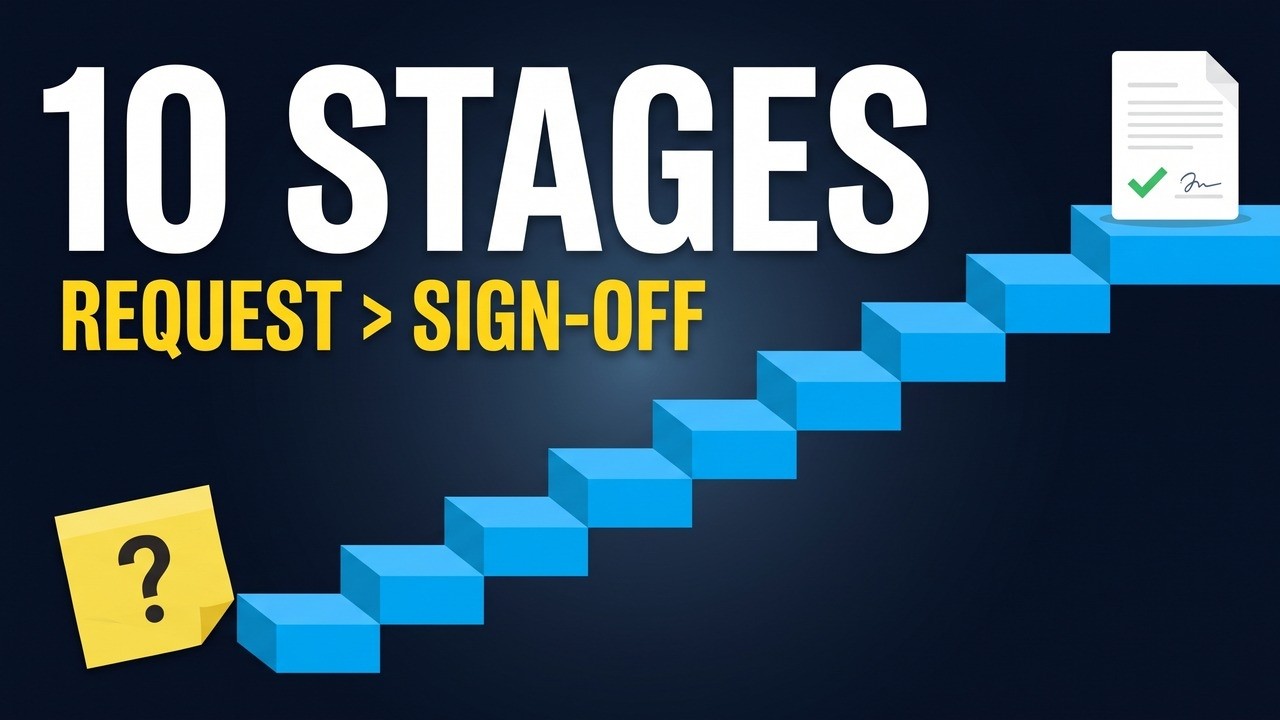
A business analyst case study, start to finish. In this video I follow one vague request at a made-up online shop, "we need an order tracking app", through 10 stages: the real problem, the goal, the stakeholders, the plan, elicitation, the options and the business case, the requirements, verify and validate, prioritize and trace, and sign-off. Every stage shows the BABOK Guide task it uses on screen, and at the end you see the signed-off requirements, how we measured the result, and the 5 mistakes to avoid.
Step by step
The request: we need an app
- The head of customer service at a made-up online shop says: we need an order tracking app. That is a solution, not a problem. The case study follows this one request through 10 stages, from the vague ask to requirements the sponsor approves.
Stage 1: find the real problem
- Stage 1 is the BABOK task analyse current state. Last month's call log shows about 1,200 calls asking where an order is, about a third of all calls. The shipping email only says the order has shipped. The problem statement: shoppers can't see where their order is, so they call.
Stage 2: agree on the goal
- Stage 2 is define future state. With the head of customer service, agree a business objective: cut the where-is-my-order calls by half within 6 months of launch. Every idea is tested against that number. Write down what is out of scope too, like changing delivery partners.
Stage 3: find the stakeholders
- Stage 3: list the stakeholders. The sponsor is the head of customer service. Add the agents, the warehouse, the delivery partner (who owns the tracking data), IT and the shoppers. Map them by power and interest. The delivery partner was nearly forgotten, and without their data there is no tracking.
Stage 4: plan the work
- Stage 4 is plan business analysis approach. Week 1: interviews and data. Week 2: a workshop and a first draft. Week 3: reviews and sign-off. Also agree governance now: the sponsor signs after the agents and IT have reviewed the requirements.
Stage 5: elicit
- Stage 5 is conduct elicitation: interview 2 agents, watch calls for an hour and read the delivery partner's data guide. Findings: shoppers want a delivery date, most calls come the day after the shipping email, and the partner can send tracking updates. Play it back to the agents to confirm.
Explain like I'm 5: the detective
- Think of it as a detective story. The request names a suspect: an app. A good detective collects clues first, like the call log, the shipping email and the agents' stories, then names the real cause with evidence. Here every clue points to shoppers not seeing where their parcel is.
The six BABOK knowledge areas
- The BABOK Guide has 6 knowledge areas: planning and monitoring, elicitation and collaboration, requirements life cycle management, strategy analysis, requirements analysis and design definition, and solution evaluation. They are not a fixed order. This case started with strategy analysis.
Stage 6: the options and the business case
- Stage 6 is define change strategy. Compare 3 options. Do nothing: free, but the calls keep coming. A tracking page, with a link and delivery date in the shipping email: about 4 weeks. A tracking app: about 6 months, and many shoppers would never download it. The business case recommends option 2.
Stage 7: specify and model
- Stage 7: model the order journey as paid, packed, shipped, out for delivery, delivered. Then write requirements, each with an ID: the email has a tracking link and delivery date, the page shows status and date, it updates on each partner status, and it loads within 2 seconds on a phone.
Stage 8: verify and validate
- Stage 8 has 2 BABOK tasks. Verify requirements checks each one is clear, complete and testable; the tester asked what happens if a parcel is late, so a new requirement was added. Validate requirements checks they meet the goal; a live map of the delivery van is parked for later.
Stage 9: prioritize and trace
- Stage 9 sits under requirements life cycle management. Prioritise: the email link and date, and the tracking page, are musts; text message updates are a could. Trace: link each requirement to the goal and to who asked for it, so the late parcel message traces to the tester's question.
Worked example: the requirements package
- The sign-off package starts with the problem and the goal (half the calls within 6 months). Then 4 requirements plus the 2-second quality requirement, each with an owner, a priority and acceptance criteria.
Stage 10: sign off
- Stage 10 is approve requirements. Walk the package through with the agents, the warehouse, IT and the delivery partner. Read acceptance criteria aloud: given a shipped order, when the shopper opens the tracking link, then they see the current status and expected delivery date. Record who approved what, and when.
After launch: measure the result
- After launch comes solution evaluation. 3 months in, calls are down from about 1,200 a month to about 700: better, but not half. Most remaining calls are about late parcels, which points to the next change. The package lives in Confluence, stories in Jira and call numbers in Excel.
5 common mistakes
- 5 common mistakes: starting with the solution, having no measurable goal, forgetting a stakeholder, skipping the business case, and treating sign-off as a signature rather than an agreement.
Recap
- Recap: find the real problem, agree the goal, find the stakeholders, plan, elicit, compare options in a business case, specify and model, verify and validate, prioritise and trace, and sign off. Then measure the result after launch.
Common mistakes
- Starting with the solution. "We need an app" is a request, not a problem. Check the data first, like the call log and the shipping email, and write a problem statement that names no solution.
- A goal you can't measure. "Better tracking" never ends. Set a number and a deadline, like half the where-is-my-order calls within 6 months, so you can test every idea and the result against it.
- Missing the stakeholder who owns the data. Here the delivery partner owned the tracking data, and without them nothing works. Ask who holds the data, not only who uses the system.
- Sign-off nobody read. Walk the package through with each group and read acceptance criteria aloud. Then record who approved what, and when.
When a business analyst uses this
When a manager asks for a specific tool, a BA can use these stages to turn the ask into a problem statement, a measurable goal and a short business case. That way, the cheaper option, like a tracking page instead of a 6-month app, gets a fair comparison in front of the sponsor.
Questions people ask
What is a business analyst case study?
It follows one business request from the first ask to signed-off requirements, showing each step a BA takes. This one goes through 10 stages, each linked to a BABOK Guide task.
How do you solve a business analyst case study in an interview?
Don't jump to the requested solution. Find the real problem with evidence, agree a measurable goal, name the stakeholders, compare options, then explain how you would write, check, prioritise and get sign-off on the requirements.
Do the BABOK knowledge areas have to be followed in order?
No. The 6 knowledge areas are not a fixed sequence, and real projects move between them. This case started with strategy analysis, then went to planning and elicitation.