
Recommended hosting
Hosting that keeps up with your content.
This site runs on fast, reliable cloud hosting. Plans start at a few dollars a month — no surprise fees.
Affiliate link. If you sign up, this site may earn a commission at no extra cost to you.
⏱ 19 min read
The average office worker sits for six hours a day. That posture doesn’t just creep into your lower back; it calcifies into your nervous system’s baseline for tension. You learn to sit still, to keep your shoulders down, to suppress the urge to shift or fidget. When you finally stand up, your body feels heavy, disconnected, and often slightly terrified of its own strength.
That is why the transition from desk to mat is not merely a change of scenery. It is a biological reset. Brazilian Jiu-Jitsu (BJJ) offers a specific, high-friction environment that forces the office body to unlearn years of protective tension. It does not offer the same kind of “sweat and shine” as a high-intensity interval run. It offers something more subtle, more structural, and ultimately more durable: a retraining of the nervous system to move with intent rather than panic.
The benefits extend far beyond the obvious physical exertion. They touch on cognitive function, emotional regulation, and the quiet confidence that comes from knowing you can handle a situation that feels slightly out of control. For the person who spends their day managing spreadsheets and emails, the mat provides a rare opportunity to manage a real opponent, one who has no regard for your title, your credentials, or your ability to type quickly.
The Kinetic Chain of Sedentary Decay
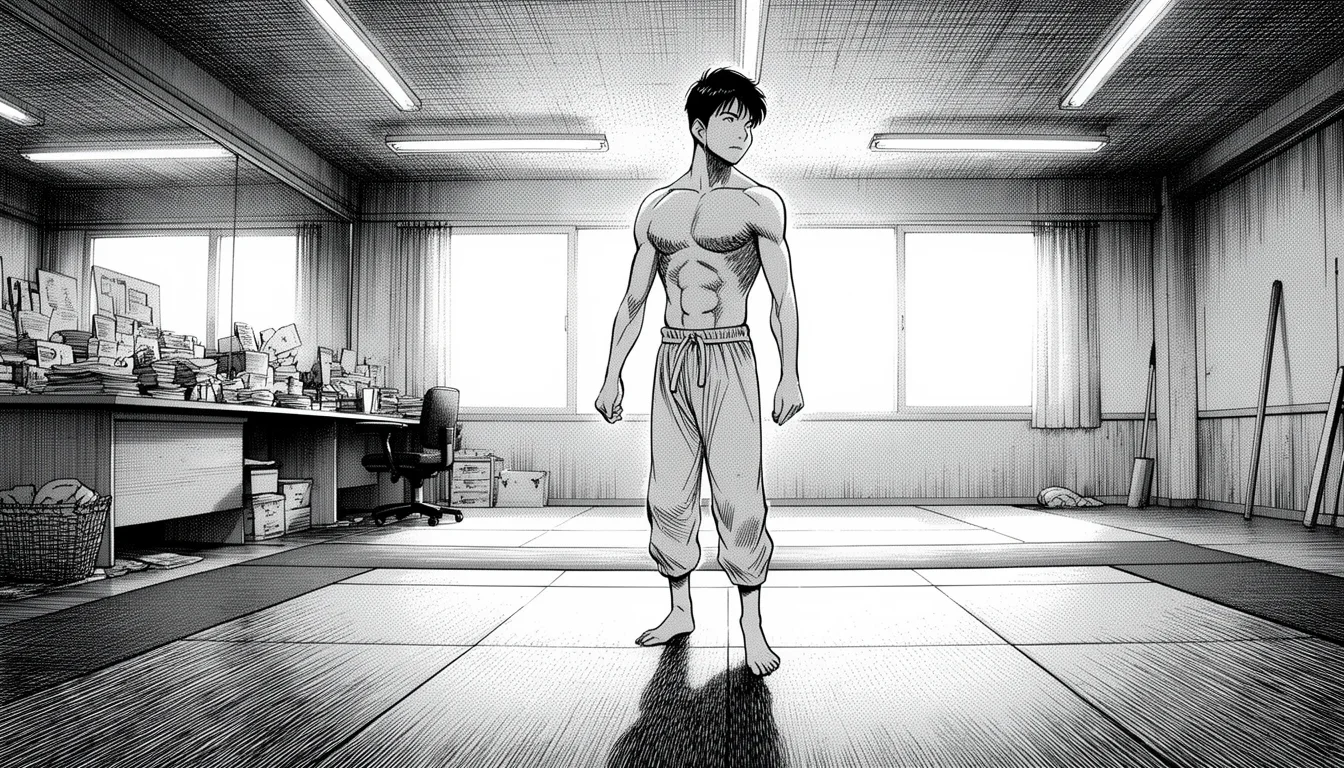
The first thing you notice when you step onto the mat after a day at the office is the stiffness. It is not the kind of stiffness that comes from a bad workout; it is the stiffness of disuse. Your hips, which should rotate freely to change direction, feel locked. Your thoracic spine, the middle section of your back, has forgotten how to extend, so you find yourself hunching forward even while standing. Your glutes, the primary engine for moving your body through space, have atrophied slightly and are now being pulled tight by the hip flexors that have been shortened by hours of sitting.
BJJ attacks this kinetic chain systematically. Unlike weightlifting, which isolates muscles, or running, which is a repetitive linear motion, BJJ is three-dimensional chaos. It forces your hips to rotate, your spine to extend, and your glutes to fire in unpredictable patterns. When you are on the ground, trying to execute a sweep or a guard pull, your body cannot rely on habit. It must react.
Consider the mechanics of a simple hip escape, or shrimp. In the gym, this is often taught as a drill to build core strength. In an office setting, it is a functional necessity. If you are trapped in a meeting chair, you cannot shrimp. But if you are trapped in a business negotiation, or worse, trapped in a physical altercation at a networking event, that shrimp motion is the difference between maintaining your center of gravity and becoming a sitting duck. BJJ teaches you that your center of gravity is not fixed; it is fluid. It moves with you if you move with it.
This is not just about fitness. It is about reclaiming agency over your body’s movement. When you leave the mat, you notice a subtle but significant shift. You don’t feel like you are running a marathon; you feel like you have been oiled. The rigid armor of the office worker has been replaced by a fluid, adaptable structure. You feel lighter, not because you are thinner, but because your muscles are finally working as a coordinated team rather than fighting against each other.
The stiffness of disuse is not a sign of weakness; it is a sign of adaptation to an environment that no longer requires full-body engagement. BJJ reverses this by reintroducing full-body engagement.
Cognitive Load and the Art of Problem Solving
There is a direct correlation between physical tension and cognitive load. When your body is tense, your brain is in a state of low-level alarm. Your cortisol levels are elevated, your attention is fragmented, and your ability to process complex information is diminished. Sitting all day keeps you in this state of low-grade vigilance. You are waiting for the next email, the next phone call, the next interruption. You are never truly at rest.
BJJ is a game of problem-solving under pressure. Every time you are on your back, facing a heavier opponent, you are presented with a problem that has no single solution. You must analyze the situation, assess your resources, and execute a plan. If the plan fails, you must immediately pivot to a new one. There is no pause button. There is no “I think about this tomorrow.” You have to solve it now, or you get submitted.
This mirrors the cognitive demands of high-level office work, but it strips away the abstraction. In the office, you can hide behind a screen. In BJJ, there is no hiding. The immediate feedback loop is visceral. If your plan is wrong, you feel it. If your timing is off, you feel it. This constant, high-stakes problem-solving trains the brain to remain calm under pressure. It teaches you to dissociate the feeling of threat from the actual execution of a solution.
Over time, this translates into your work life. When a crisis hits—a missed deadline, a client complaint, a sudden market shift—you find yourself reacting with a different kind of clarity. You are not paralyzed by the fear of failure. You are focused on the next move. This is not magic; it is neuroplasticity. The brain is rewiring itself to handle uncertainty not as a threat, but as a puzzle to be solved.
The mental discipline required to stay calm while being choked out is the same discipline required to stay focused during a long, difficult project. It is the ability to endure discomfort without losing your head. For the office worker, this is a superpower. Most people react to stress with a fight-or-flight response that shuts down higher-order thinking. BJJ practitioners learn to stay in the present moment, to focus on the immediate task, and to ignore the noise of the future.
The Social Ecosystem of the Dojo
Office life is often a series of transactions. You exchange emails for answers, meetings for decisions, and calls for resolutions. It is a world of polite distance, where conflict is managed through avoidance and professional detachment. But the mat is different. It is a social ecosystem built on trust and mutual respect, not hierarchy or titles.
In a typical office, your value is determined by your performance metrics, your title, your network. On the mat, your value is determined by your willingness to learn and your ability to apply what you have learned. A CEO and a janitor are equally likely to be tapped on the chin. A senior manager and a junior associate are equally likely to end up on their backs. The social dynamics are stripped of the usual office pretenses.
This environment fosters a unique kind of camaraderie. You learn to help others up when they fall. You learn to tap out when you can’t win, not because you are defeated, but because you respect the rules of the game. You learn to communicate clearly and concisely, because confusion on the mat can be dangerous. These are soft skills that translate directly to the workplace.
The dojo is also a place where you can drop the mask. You don’t have to be the “strong, confident professional” you present to your boss. You can be a beginner. You can be confused. You can make mistakes. And as long as you are willing to learn, you are welcome. This sense of belonging, of being part of a community that values growth over perfection, is a powerful antidote to the isolation that often comes with office work.
The dojo is a place where you can drop the mask. You don’t have to be the “strong, confident professional” you present to your boss. You can be a beginner. You can be confused. You can make mistakes. And as long as you are willing to learn, you are welcome.
Injury Prevention and Physical Longevity
Office workers are at high risk for chronic injuries, particularly in the lower back, neck, and wrists. The repetitive strain of typing, the static posture of sitting, and the occasional awkward lifting of a heavy box or a stack of files all add up. These injuries often start as minor aches and pains that are ignored until they become chronic. By the time you see a doctor, the damage is done, and the treatment is often a cycle of medication and rest that fails to address the root cause.
BJJ is a full-body workout that emphasizes mobility and stability. It teaches you how to move your body safely, how to protect your joints, and how to generate force without relying on brute strength. The techniques you learn on the mat are designed to be efficient, using leverage and momentum rather than muscle power. This efficiency carries over into your daily life. You learn to lift things correctly, to twist your spine safely, and to engage your core before you move.
Furthermore, BJJ improves your balance and coordination. These are skills that decline with age, but regular practice can help maintain them. A person who practices BJJ is less likely to fall, less likely to sprain an ankle, and less likely to suffer from the kind of joint pain that plagues many older adults. This is not just about living longer; it is about living better. It is about maintaining the independence and mobility that allow you to enjoy your life, whether that means playing with your grandchildren or taking a hike on the weekend.
The injury prevention aspect of BJJ is also about understanding your body. You learn to listen to your joints, to feel the limits of your range of motion, and to push those limits safely. You learn that pain is not always a sign of injury, and that discomfort is often a sign of growth. This distinction is crucial for the office worker, who is often afraid of pain and tends to push through it until something breaks. BJJ teaches you to respect your body, to treat it as a tool that needs maintenance, and to take care of it.
The Hidden Cost of Avoidance
One of the most surprising benefits of BJJ for office workers is the reduction in avoidance behaviors. In the office, we are trained to avoid conflict. We avoid difficult conversations. We avoid taking risks. We avoid making mistakes. This avoidance is often a survival mechanism, a way to protect ourselves from criticism or failure. But it also leads to stagnation. It prevents us from growing, from learning, and from achieving our full potential.
BJJ forces you to face conflict directly. It forces you to engage with someone who wants to hurt you, to outmaneuver you, to defeat you. There is no way to avoid this. You have to be there. You have to fight. This repeated exposure to conflict, in a controlled and safe environment, desensitizes you to the fear of it. It teaches you that you can survive conflict, that you can win even when you are at a disadvantage, and that you can learn from your mistakes.
This mental shift is profound. When you return to the office, you find yourself less afraid of difficult conversations. You are less afraid of making mistakes. You are less afraid of taking risks. You are more willing to speak up, to challenge the status quo, and to push for what you believe in. You are more confident in your ability to handle adversity. This confidence is not arrogance; it is a deep-seated knowledge of your own capabilities.
The hidden cost of avoidance is a life lived in fear. BJJ helps you break that cycle. It teaches you that fear is a natural response, but it does not have to control your actions. It teaches you to act despite fear, to move forward even when you are scared. This is a lesson that applies to every aspect of life, from your career to your relationships to your health. It is a lesson in courage, in resilience, and in the power of action.
Fear is a natural response, but it does not have to control your actions. BJJ teaches you to act despite fear, to move forward even when you are scared.
Comparing BJJ to Other Fitness Options for Desk Workers
Not all exercise is created equal when it comes to reversing the effects of a sedentary lifestyle. While running and lifting are excellent for cardiovascular health and muscle building, they do not offer the same kind of functional, full-body engagement as BJJ. The table below breaks down the key differences between BJJ and other popular fitness options for office workers.
| Feature | Brazilian Jiu-Jitsu (BJJ) | Running / Cardio | Weightlifting | Yoga / Pilates |
|---|---|---|---|---|
| Primary Focus | Grappling, leverage, problem-solving | Endurance, heart health | Muscle strength, hypertrophy | Flexibility, core stability |
| Impact on Posture | Dynamic extension, rotational mobility | Limited (linear motion) | Static strength, can reinforce stiffness | Excellent for alignment and flexibility |
| Stress Reduction | High (active coping mechanism) | Moderate (endorphins) | Moderate (focus, achievement) | High (relaxation, breathwork) |
| Conflict Resolution | Direct, physical engagement | None | None | Low (internal conflict) |
| Learning Curve | Steep, long-term mastery | Immediate improvement | Immediate improvement | Immediate improvement |
| Social Interaction | High, team-based | Low, individual | Variable, group or solo | Variable, group or solo |
Best for: People who want a workout that challenges their mind as much as their body, improves dynamic mobility, and builds confidence in handling pressure. BJJ is particularly effective for those who feel disconnected from their bodies or who struggle with the monotony of traditional gym routines.
Trade-offs: BJJ requires a significant time commitment. Classes are often 90 minutes to two hours, and the learning curve is steep. It can be physically demanding, and beginners may experience soreness that lasts for days. It is not a “quick fix” solution; it requires consistent, long-term practice to see the full benefits.
Common Mistakes Office Workers Make When Starting BJJ
Starting BJJ is a journey, but there are pitfalls that are particularly common for people coming from an office background. These mistakes often stem from trying to apply office logic to a martial art, or from underestimating the physical demands of the sport. Here are the most common errors to avoid.
- Relying on Strength Over Technique: This is the number one mistake. Office workers often pride themselves on their ability to handle complex tasks, so they assume they can handle a fight with their mind or their intellect. In BJJ, size and strength matter less than technique and leverage. Trying to overpower an opponent on the mat is a surefire way to get submitted. Learn to use your opponent’s weight against them.
- Ignoring the Warm-Up: Office workers are used to sitting down and starting their work immediately. They are not used to warming up their bodies before physical activity. Skipping the warm-up in BJJ increases the risk of injury and reduces your performance. Take the time to move your joints, activate your core, and get your blood flowing before you step onto the mat.
- Trying to Be Perfect: In the office, mistakes are often penalized. In BJJ, mistakes are learning opportunities. Trying to be perfect can lead to hesitation, which is dangerous on the mat. Embrace the mistake, learn from it, and move on. The goal is progress, not perfection.
- Comparing Yourself to Others: Everyone starts at a different point. Some people have a background in martial arts; others have never been active before. Comparing yourself to others only serves to discourage you. Focus on your own progress, your own improvements, and your own journey.
- Neglecting Recovery: BJJ is physically demanding. Your body needs time to recover from the stress of training. Neglecting recovery can lead to burnout, injury, and a decrease in performance. Make sure you are getting enough sleep, eating well, and taking rest days when needed.
A Practical Guide to Integrating BJJ into a Busy Schedule
One of the biggest concerns for office workers is finding the time for BJJ. With long hours, meetings, and deadlines, it can feel impossible to fit in a workout. However, with some planning and commitment, BJJ can become a manageable part of your routine. Here are some practical tips for integrating BJJ into a busy schedule.
- Schedule It Like a Meeting: Treat your BJJ class like an important meeting. Block off the time on your calendar, set a reminder, and treat it as non-negotiable. If you would never miss a client meeting, do not miss your BJJ class.
- Find a Convenient Location: Look for a gym that is close to your office or home. The closer the gym is, the more likely you are to go. If you have to drive a long way, you might not make it. Find a gym that is convenient for your schedule.
- Start with Drop-In Classes: If you are unsure about committing to a monthly membership, start with drop-in classes. This allows you to try out different gyms and find one that fits your style and schedule. Once you find a gym you like, consider signing up for a membership.
- Combine Work and Training: If you work from home, try to combine your work and training. You can do some light stretching or yoga during your lunch break, and then head to the gym after work. This can help you stay active throughout the day without sacrificing too much of your work time.
- Be Consistent: Consistency is key. Even if you can only train two or three times a week, try to stick to a regular schedule. Consistency will help you build the habits and routines that are necessary for long-term success.
The Long-Term Impact on Career and Life
The impact of BJJ on your career and life extends far beyond the physical benefits. It changes the way you think, the way you move, and the way you interact with the world. It builds a level of confidence and resilience that can help you navigate the challenges of the modern workplace. It teaches you to stay calm under pressure, to think clearly in difficult situations, and to respect the strength of others.
For office workers, BJJ can be a transformative experience. It can help you break free from the limitations of a sedentary lifestyle, improve your physical and mental health, and build a sense of community that you may not find in the office. It can teach you to embrace challenges, to learn from mistakes, and to grow as a person. It is more than just a workout; it is a way of life.
BJJ is more than just a workout; it is a way of life. It can teach you to embrace challenges, to learn from mistakes, and to grow as a person.
FAQ
How long does it take to see the benefits of BJJ for office workers?
You will feel physical benefits, such as improved posture and reduced stiffness, within the first few weeks of consistent training. Cognitive and mental benefits, such as increased confidence and stress reduction, may take a few months to fully develop as your brain adapts to the new demands of the sport. However, the first class will often provide an immediate sense of relief from the tension of the office.
Can I practice BJJ if I have a back injury?
It is possible to practice BJJ with a back injury, but you should consult with a doctor or physical therapist before starting. BJJ can be beneficial for back health, but it requires proper technique and conditioning. A qualified instructor can help you modify your training to accommodate your injury and prevent further damage.
Is BJJ suitable for people with no athletic background?
Yes, BJJ is suitable for people with no athletic background. In fact, many of the best BJJ practitioners started with little to no athletic experience. The sport is accessible to everyone, regardless of size, age, or fitness level. The focus is on technique and leverage, not brute strength.
How often should I train BJJ to see results?
For the best results, aim to train at least two to three times a week. Consistency is key, and regular practice will help you build the habits and routines necessary for long-term success. Even one class a week can provide benefits, but more frequent training will accelerate your progress.
Does BJJ help with stress and anxiety?
Yes, BJJ is an excellent stress reliever. The physical activity releases endorphins, and the mental challenge of solving problems under pressure helps to clear the mind. The social aspect of the dojo also provides a sense of community and support, which can be helpful for managing anxiety.
Is BJJ expensive for office workers on a budget?
The cost of BJJ can vary depending on the gym and the membership plan. Many gyms offer trial classes or drop-in rates for those who want to try the sport before committing to a membership. Some gyms also offer discounts for students or those on a budget. It is worth shopping around to find a gym that fits your budget.
Use this mistake-pattern table as a second pass:
| Common mistake | Better move |
|---|---|
| Treating From Desk to Mat: Surprising Benefits of BJJ for Office Workers like a universal fix | Define the exact decision or workflow in the work that it should improve first. |
| Copying generic advice | Adjust the approach to your team, data quality, and operating constraints before you standardize it. |
| Chasing completeness too early | Ship one practical version, then expand after you see where From Desk to Mat: Surprising Benefits of BJJ for Office Workers creates real lift. |
Further Reading: American College of Sports Medicine guidelines for office workers
Newsletter
Get practical updates worth opening.
Join the list for new posts, launch updates, and future newsletter issues without spam or daily noise.

Leave a Reply